
Last updated: July 2026 Reviewed by the BC commercial property management team at Duka Management
Industrial property management is not just commercial property management with larger square footage.
Warehouses, light industrial buildings, flex industrial sites, distribution spaces, service yards, and strata industrial complexes carry different operating risks than an office or retail property. A failed bay door can delay shipments. Poor drainage can damage stored goods. An access problem can affect trucks, tenants, customers, and contractors at the same time. A missed fire-safety deficiency can become more than an administrative issue.
For BC owners, industrial property management should be measured by how well it protects the asset, supports tenant or occupant operations, controls vendors, tracks risk, and keeps building information visible before problems become expensive.
This article is educational information, not legal, leasing, accounting, tax, engineering, insurance, safety, or investment advice. Owners and councils should rely on qualified professionals for property-specific decisions.
What Industrial Property Management Means
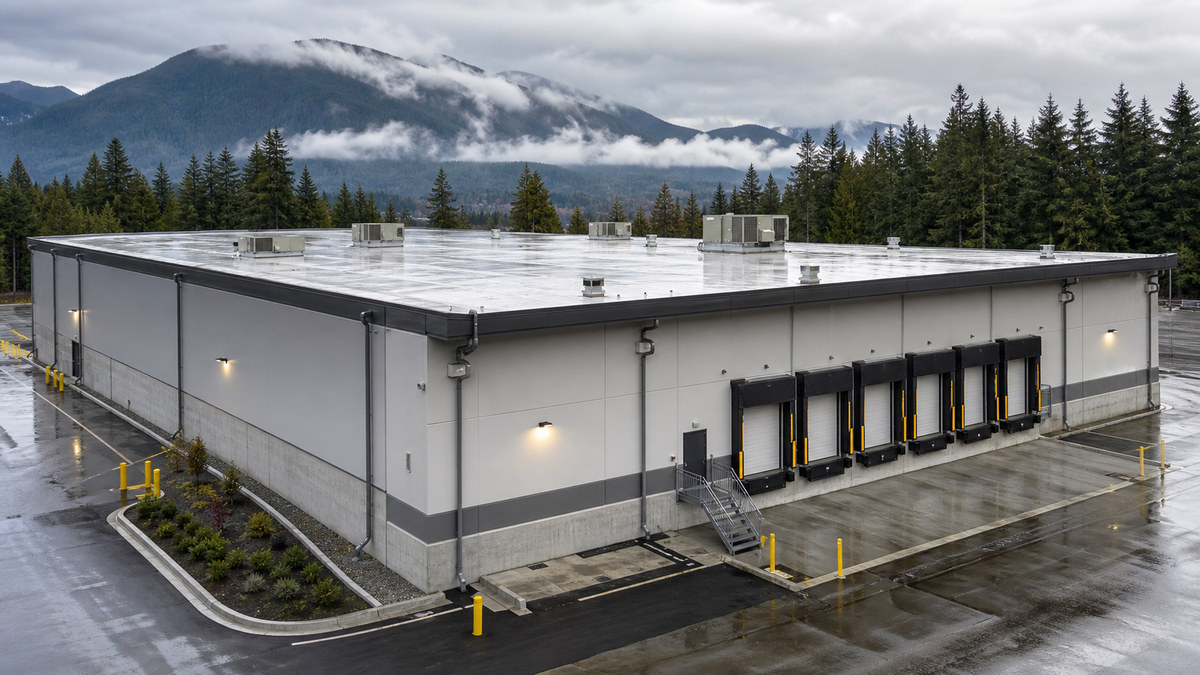
Industrial property management is the day-to-day operating structure used to manage industrial buildings and industrial-use properties. The work may support a single owner, an asset company, a commercial strata corporation, or a mixed-use commercial property with industrial components.
Depending on the property, the manager may help coordinate:
- maintenance planning and service response
- vendor sourcing and contractor follow-up
- site inspections and work orders
- tenant or occupant communication
- operating budgets and owner reporting
- insurance and risk documentation
- emergency response coordination
- records for building systems, contracts, and warranties
- capital repair planning support
The manager does not replace the owner, asset manager, leasing team, legal counsel, engineer, insurance advisor, or safety professional. The manager helps organize execution so the building is not run by memory, scattered emails, and emergency calls.
Duka’s commercial property management services in BC are relevant to industrial assets because industrial buildings need more than basic administration. They need organized maintenance, clear reporting, communication, vendor coordination, and practical follow-through.
How Industrial Assets Differ From Office and Retail Properties
Industrial buildings are often more operationally intense than they look from the outside.
An office building may be judged by lobby experience, comfort, cleaning, security, elevators, and tenant service. A retail property may be judged by customer access, signage, parking, presentation, waste control, and tenant visibility. Industrial properties add another layer: movement of goods, vehicles, equipment, supplies, loading activity, storage needs, yard use, power demands, ventilation, and sometimes specialized tenant operations.
That changes the risk profile. Small failures can affect business continuity quickly.
Examples include:
- a damaged overhead door that blocks loading
- roof drainage problems that affect stored inventory
- exterior lighting failures that create security concerns
- clogged yard drains that interrupt vehicle movement
- poor waste-area control that affects safety and appearance
- HVAC or exhaust issues that affect unit operations
- unclear access rules for trucks, vendors, and after-hours users
Industrial property management has to connect these issues to the bigger asset picture. A work order is not only a work order. It may be a warning sign about traffic flow, deferred maintenance, tenant use, contractor quality, or capital replacement timing.
Preventative Maintenance Priorities for BC Industrial Buildings
Preventative maintenance matters in any commercial property, but industrial buildings often punish delay faster.
BC weather adds pressure. Heavy rain, wind, temperature swings in some regions, summer heat, smoke conditions, and moisture exposure can all affect building performance. Industrial roofs, drains, exterior doors, service yards, loading areas, and mechanical systems need regular attention because they sit close to tenant operations.
Roofs, Drainage, and BC Climate Resilience
Roofs and drainage should be treated as core industrial asset risks.
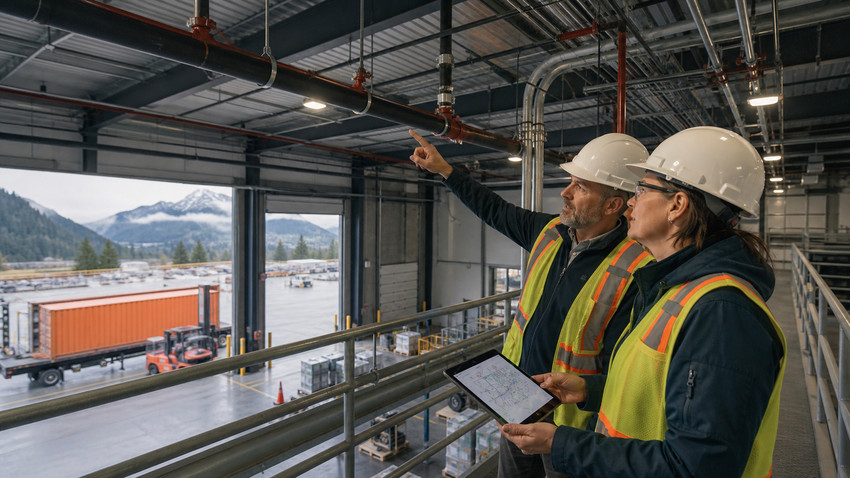
Many industrial buildings have large roof areas, flat or low-slope roof sections, rooftop equipment, gutters, scuppers, drains, skylights, penetrations, and exterior wall assemblies that need regular inspection. During heavy coastal rain or atmospheric river events, a small drainage issue can move from “maintenance item” to “tenant disruption” quickly if water reaches inventory, equipment, electrical rooms, racking, or customer areas.
A practical management process should track roof inspections, drain cleaning, leak history, contractor reports, warranty information, and recurring trouble spots. It should also separate a one-time repair from a pattern. If the same area keeps leaking, the owner needs better information than “vendor attended.”
Loading Docks, Bay Doors, and Yard Areas
Industrial properties often depend on access systems that are easy to ignore until they fail.
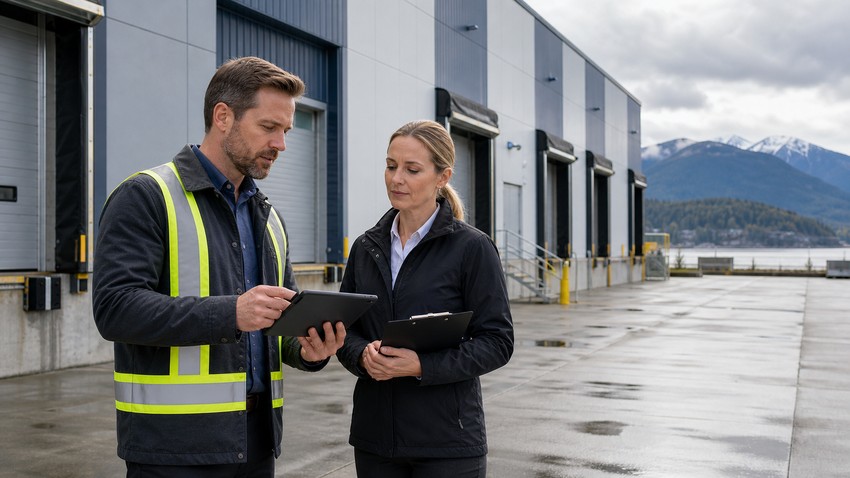
Loading docks, overhead doors, dock levellers, bollards, gates, access-control systems, yard lighting, pavement, curbs, drains, and traffic paths can all affect tenant operations. A poorly maintained loading area creates operational frustration and can increase damage, safety exposure, and emergency repair costs.
Management should track recurring impacts, door failures, pavement deterioration, drainage complaints, lighting issues, unauthorized parking, and tenant-caused damage. Where the property is leased, the management agreement and lease terms should clarify how owner, tenant, and contractor responsibilities are handled.
Mechanical, Electrical, and Life-Safety Systems
Industrial buildings may include rooftop units, make-up air units, exhaust systems, unit heaters, pumps, electrical rooms, panels, lighting controls, fire alarm components, sprinklers, extinguishers, emergency lighting, and access systems.
BC’s Fire Code page explains that the BC Fire Code is a provincial regulation covering fire-safety requirements for existing buildings and facilities. Property managers are not fire-code consultants, but management still needs to track inspection reports, deficiencies, contractor recommendations, and owner approvals so life-safety work does not disappear into a filing folder.
Risk Management Is Part of Asset Protection
Industrial property risk is not limited to emergency events.
Risk also shows up in incomplete records, unclear contractor scopes, expired insurance documents, missed inspection follow-up, poor communication, tenant modifications, repeated damage, and unresolved maintenance patterns. The building may still be operating, but the owner’s visibility is weak.
A stronger risk process should include:
- current vendor insurance and compliance documentation
- service contracts and scopes of work
- inspection and deficiency logs
- incident notes and photo records
- maintenance history by system or area
- tenant or occupant notices
- budget and approval records
- emergency contact and escalation procedures
This is where building envelope and technical consulting can become useful. If a roof, drainage, mechanical, electrical, or envelope issue keeps returning, the owner may need more than another service call. They may need help understanding the pattern, the options, the budget impact, and the right professional to involve.
Vendor Management and WorkSafeBC Compliance
Industrial properties usually rely on many vendors: roofers, plumbers, electricians, HVAC contractors, fire-safety contractors, paving contractors, overhead door specialists, landscapers, snow contractors, waste vendors, restoration companies, security providers, cleaning teams, and general contractors.
The management issue is not just finding someone available. It is controlling scope, timing, quality, documentation, access, and follow-up.
Good vendor management asks:
- Is the scope clear enough for comparison?
- Is the contractor qualified for the work?
- Is access coordinated with tenants or occupants?
- Are insurance and safety documents current?
- Are deficiencies being closed?
- Are repeat issues being escalated?
- Is the owner receiving enough information to approve the next step?
The Province of BC’s strata maintenance guidance also emphasizes qualified personnel and WorkSafeBC requirements when repair and renewal work is performed. WorkSafeBC’s prime contractor guidance is especially relevant when multiple employers or contractors may be active on site. Even when the property is not a strata, the same operating discipline is useful: clarify responsibility, use qualified vendors, document the work, and keep the owner informed.
Commercial Strata Nuance in BC
Not every industrial property in BC is a strata property. Some are fee-simple assets with one owner. Others are industrial strata complexes, mixed-use strata developments, or properties with shared facilities and layered cost arrangements.
The Province of BC explains that strata properties can include industrial, commercial, and mixed-use strata developments, and that owners share common property and common assets through a strata corporation.
That matters because industrial property management changes when a strata corporation is involved. The manager may need to understand strata bylaws, common property, limited common property, sections, repair responsibilities, council authority, owner approvals, and how costs are allocated.
For example, an issue with a loading area may raise several questions:
- Is it common property, limited common property, or part of a strata lot?
- Is the repair the strata corporation’s responsibility or an owner’s responsibility?
- Did an owner or tenant cause the damage?
- Is there a bylaw, lease, section, or agreement that affects cost recovery?
- Does the council need legal, engineering, insurance, or contractor input?
BC guidance says strata corporations must maintain and repair shared common property and assets, while planning, budgeting, qualified contractors, documentation, and communication all matter. In an industrial strata, those requirements are not abstract. They affect loading access, roads, yards, building systems, shared services, and owner confidence.
If your property has strata governance, Duka’s industrial strata management services are relevant because the operating work has to fit the Strata Property Act, bylaws, council decisions, owner communication, financial reporting, and maintenance follow-through.
Tenant and Occupant Communication
Industrial communication is often more operational than promotional.
Tenants and occupants need to know when vendors are coming, when loading areas will be affected, when water or power interruptions are expected, where trucks can stage, how after-hours access works, what to do during emergencies, and how to report common-area problems.
Poor communication creates avoidable conflict. A roof repair that is technically well managed can still become a tenant problem if access, timing, odours, noise, parking, or loading impacts are not explained clearly.
For leased industrial properties, communication should also respect the lease structure. Some operating costs, repairs, or responsibilities may sit with the tenant, the owner, or both. The manager should not guess. The manager should help route the issue correctly, document the communication, and escalate when lease interpretation or legal advice is needed.
What Owners Should Expect From Industrial Property Management
Industrial owners should expect more than basic work-order forwarding.
A practical management relationship should provide:
- regular site visibility
- maintenance and vendor tracking
- useful financial reporting
- tenant or occupant communication support
- clear emergency escalation
- records that survive staff or manager turnover
- budget context for repair decisions
- early warning when repeat issues point to bigger asset risk
The owner should also understand the scope. Some management agreements include lease administration, rent reporting, or tenant-account support. Others focus more heavily on building operations. Commercial strata management is different again because the strata corporation, not one landlord, may be the management client.
The best proposals are specific about authority, reporting, after-hours expectations, vendor approval limits, records, meetings, communication, and what is outside scope.
How Duka Supports BC Industrial and Commercial Assets
Duka’s BC service model connects property management, strata management, financial reporting, communication, vendor coordination, and consulting support. For industrial owners and commercial strata councils, that combination matters because industrial building issues rarely sit in one neat category.
A loading-area problem can involve maintenance, tenant communication, insurance, safety, budget approval, and future capital planning. A roof leak can involve emergency response, contractor coordination, recordkeeping, tenant impact, and consulting input. A recurring access problem can involve bylaws, lease terms, signage, security, and vendor scheduling.
Learn more about Duka Management’s BC team, review the BC property management FAQ, or contact the BC office if your property needs a more organized operating model.
FAQ: Industrial Property Management in BC
What is industrial property management?
Industrial property management is the professional management of warehouses, flex industrial buildings, service yards, distribution properties, industrial strata complexes, and similar business-use assets. It focuses on maintenance, vendors, access, communication, reporting, risk documentation, and asset protection.
Is industrial property management the same as commercial property management?
It is a specialized part of commercial property management. Industrial buildings usually have heavier demands around loading, access, yard areas, roof drainage, overhead doors, mechanical systems, tenant operations, safety documentation, and business continuity.
Does the Strata Property Act apply to industrial properties in BC?
It can. BC strata developments may include industrial, commercial, and mixed-use properties. If an industrial property is structured as a strata, the Strata Property Act, bylaws, common property, limited common property, council authority, and shared-cost decisions may affect management.
What maintenance priorities matter most for industrial buildings?
Common priorities include roofs, drains, loading docks, overhead doors, yard areas, pavement, exterior lighting, HVAC, electrical systems, fire and life-safety systems, access control, waste areas, and any systems whose failure would disrupt tenant operations.
Why does vendor oversight matter for industrial assets?
Vendor oversight protects cost, quality, safety, documentation, and follow-through. Industrial buildings often rely on specialized contractors, and weak coordination can lead to repeat failures, unclear invoices, access conflicts, and avoidable downtime.
Final Thoughts
Industrial property management in BC should protect more than the appearance of the building. It should protect operations, asset value, tenant continuity, records, vendor quality, and owner visibility.
For warehouses, flex industrial sites, industrial strata complexes, and commercial assets with heavy operational demands, the right management process can make recurring issues visible earlier and help owners act before the building drifts into avoidable risk.
If your BC industrial or commercial property needs stronger management support, review Duka’s BC property management services or request a BC property management proposal.