
Last updated: April 2026 Reviewed by the BC commercial property and strata management team at Duka Management
Commercial property maintenance in BC is one of the clearest separators between a stable building and a building that keeps drifting into avoidable emergencies. In British Columbia, that matters for office properties, retail sites, mixed-use assets, and commercial strata buildings alike. Heavy coastal rain, freeze-thaw cycles, and summer smoke can all put additional pressure on building systems.
Too many buildings still treat maintenance as a repair queue: wait for the complaint, call the trade, pay the invoice, repeat. That approach usually produces more disruption, shorter equipment life, and weaker budgeting.
The better approach is structured, documented, and proactive. Good commercial property maintenance is not just about fixing what is broken. It is about inspecting critical systems before failure, tracking recurring deficiencies, sequencing work sensibly, and connecting everyday upkeep to longer-range capital planning. That is the operating mindset behind stronger property management services in BC.
For commercial strata and mixed-use properties in BC, that discipline also supports governance. Maintenance records, depreciation planning, contractor coordination, and budget decisions all connect back to how well the building is being managed.
This article is general educational information, not legal advice. For legal interpretation of contracts, bylaws, the Strata Property Act, or dispute strategy, obtain BC legal advice.
What Preventative Maintenance Actually Means
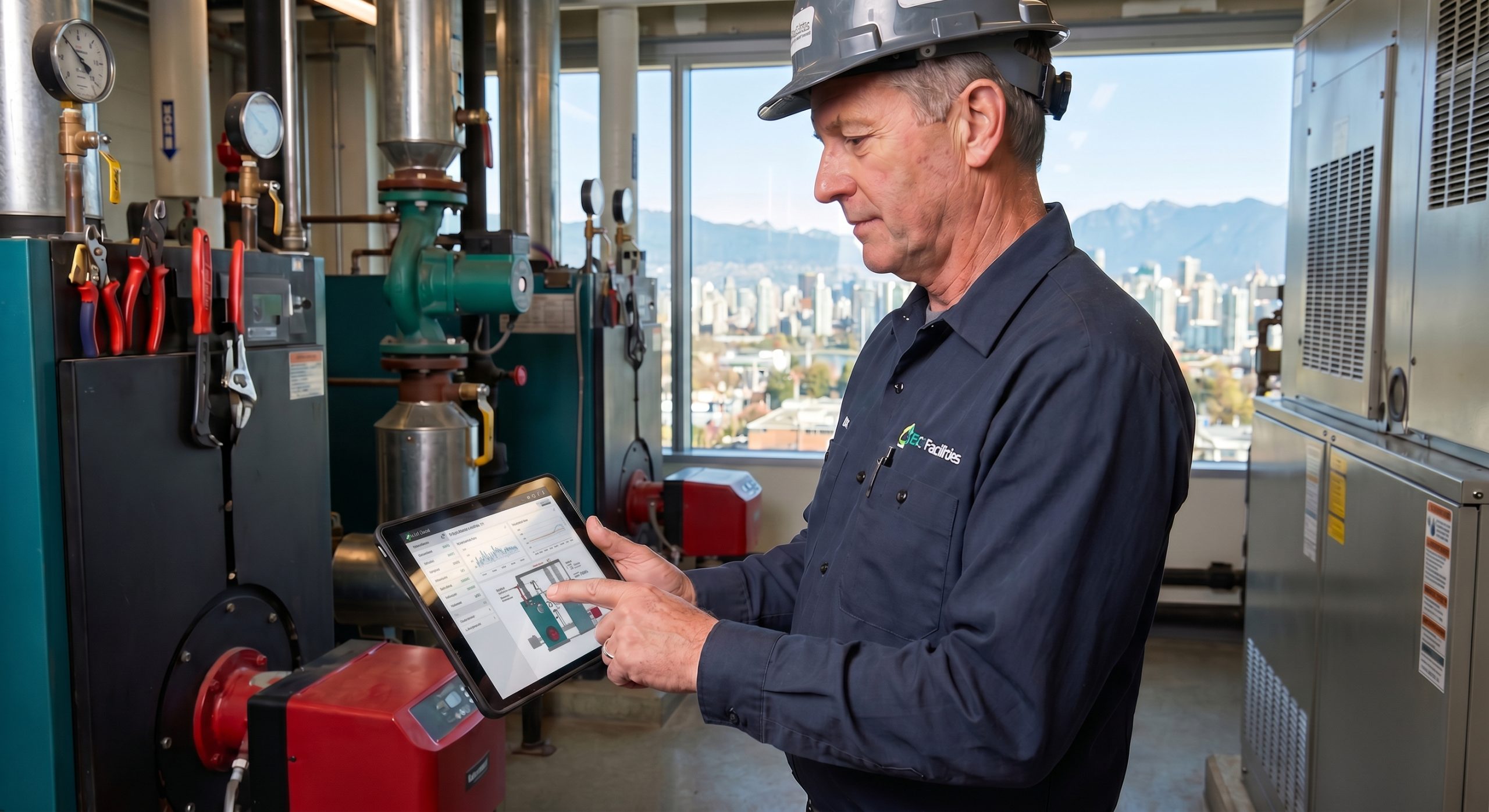
Preventative maintenance is scheduled building care designed to reduce breakdowns, extend component life, and catch small issues before they become capital problems.
In a commercial building, that usually includes:
- regular inspections of roofs, drainage paths, windows, doors, and exterior assemblies
- scheduled service for HVAC, plumbing, electrical, and life-safety systems
- documented testing, cleaning, lubrication, filter changes, calibration, and minor repairs
- maintenance logs that show what was inspected, what was found, and what still needs follow-through
That is different from purely reactive maintenance. Reactive maintenance waits for failure. Preventative maintenance assumes that systems age, weather exposure accumulates, and routine attention is cheaper than crisis response.
In practice, the right maintenance program is not a massive spreadsheet no one uses. It is a working system: inspection schedules, vendor scopes, building records, open-item tracking, and decision-making discipline.
Why Reactive Maintenance Costs More in Commercial Buildings
Commercial buildings do not absorb disruption as easily as smaller residential properties. A failed rooftop unit in an office or retail property can affect tenant operations immediately. Drainage problems can damage interiors, interrupt access, and create repeat calls if the root cause is never addressed. Deferred repairs on doors, lighting, fire systems, or loading areas can create both safety exposure and reputational damage.
Reactive maintenance also creates financial noise:
- emergency call-outs cost more than planned service
- repeated short-term repairs can exceed the cost of doing the work properly
- owners and councils lose visibility into what is routine versus what is now capital
- vendors spend more time diagnosing urgent failures than completing planned work efficiently
Commercial Building Maintenance Checklist: Key Systems
The strongest maintenance plans do not treat every building component the same. They prioritize systems that create the highest operational, safety, and cost exposure if they fail.
Building Envelope and Drainage
Water remains one of the most expensive maintenance risks in BC. Commercial buildings and mixed-use properties need regular attention on roofs, drains, flashings, sealants, windows, membranes, and exterior penetrations.
In coastal and Lower Mainland conditions, small envelope failures rarely stay small for long. A blocked drain or failed sealant joint can escalate into interior damage, tenant disruption, or more extensive repair scope.
At a minimum, the maintenance program should include:
- seasonal roof and drain inspections
- tracking of known leak locations and repairs
- periodic review of exterior sealant and exposed assemblies
- clear documentation after major weather events or repeated water entry
Mechanical, Electrical, and Plumbing Systems
Commercial buildings depend on equipment that tenants and visitors usually notice only when it stops working. HVAC systems, pumps, domestic water systems, electrical panels, controls, exhaust, and lighting all require planned service, not just emergency response.
Preventative work in this area often includes:
- filter changes and seasonal HVAC servicing
- reviewing abnormal noise, vibration, or temperature complaints
- checking pumps, controls, and valves
- inspecting electrical rooms, panels, and backup systems where applicable
- identifying deferred items before they become service interruptions
This is also where maintenance records matter. If the building has recurring complaints about heating, cooling, odours, or power quality, the answer is not just dispatching another vendor. In BC, that can also mean preparing for smoke-related filter loading in summer and heavier moisture-management demands through the fall and winter.
Life Safety, Security, and Access Systems
Commercial buildings also depend on systems where failure creates immediate operational pressure. Fire alarm components, sprinklers, extinguishers, emergency lighting, access control, intercoms, overhead doors, and elevators all need routine testing and maintenance.
BC’s fire safety framework is governed through the BC Fire Code 2024, which came into effect on March 8, 2024. That does not mean every property manager becomes a code consultant, but it does mean life-safety systems cannot be treated casually. Inspection cycles, deficiencies, contractor reports, and remedial work all need clear tracking.
For many commercial properties, the issue is not whether inspections occur. It is whether deficiency follow-up is being closed properly.
How to Build a Maintenance Program That Actually Works
A maintenance program becomes useful when it is structured around real building information rather than good intentions.
Start with an asset list. The building should have a basic record of major systems, equipment, service history, warranties where available, and known problem areas. BC guidance on repair and maintenance documentation is helpful here because without records, continuity breaks down every time managers, contractors, or council members change.
Then build a practical schedule around the building’s actual systems:
- monthly items
- seasonal items
- annual inspections and testing
- multi-year recurring work
The schedule should also distinguish between routine operating work, preventative maintenance, and capital repair or renewal planning. Cleaning a drain, servicing a unit heater, and replacing a failed rooftop unit are not the same type of event, even if they all fall under “maintenance” in conversation.
The next step is follow-through discipline:
- open issues should be logged
- vendor recommendations should be reviewed and prioritized
- completed work should be documented
- recurring issues should be escalated rather than repeatedly patched
If the program does not generate usable records, the building is not really running preventative maintenance. It is just reacting in a more organized way.
A Simple Seasonal Maintenance Rhythm
Most commercial buildings benefit from a basic seasonal rhythm instead of one undifferentiated list.
- Spring: inspect roofs, drains, sealants, membranes, and any winter-related deterioration
- Summer: review cooling performance, controls, exhaust, and filter conditions during peak demand
- Fall: clear drains and gutters before heavy rain, confirm lighting and weather protection, and prepare heating systems
- Winter: monitor freeze exposure, access systems, leak risk, and response readiness during storms
That kind of checklist is simple, but it helps the building move from memory-based maintenance to repeatable maintenance.
BC Regulations: Strata Laws, Fire Codes, and WorkSafeBC
Not every commercial building in BC sits inside a strata structure. But many commercial and mixed-use properties do, and those buildings have an extra governance layer that directly affects maintenance planning.
If your building is part of a commercial strata or mixed-use strata, the Strata Property Act matters. The strata corporation is responsible for maintaining and repairing common property and common assets. That means preventative maintenance is not just a best practice. It is part of how the property meets its operating obligations.
Depreciation Reports Now Matter More
BC’s depreciation report rules tightened on July 1, 2024. For strata corporations with five or more lots, depreciation reports are now generally required on a five-year cycle, and the older annual 3/4 vote deferral approach was removed.
The current BC government deadlines matter as well. Strata corporations without a compliant report, or with reports received before December 31, 2020, generally must obtain reports by:
- July 1, 2026 in Metro Vancouver, the Fraser Valley, and the Capital Regional District, subject to the province’s regional exceptions
- July 1, 2027 in the rest of British Columbia
For a commercial or mixed-use strata, that means boards and councils need stronger coordination between:
- the depreciation report
- ongoing maintenance work
- contingency reserve planning
- project timing and procurement
This matters because a depreciation report is not a substitute for routine maintenance. BC guidance is explicit on that point.
Documentation Is Not Optional If You Want Continuity
BC guidance on repair and maintenance documentation highlights the value of:
- service contracts
- repair and replacement records
- maintenance plans and manuals
- maintenance logs
In a commercial building, documentation helps with budgeting, warranty questions, repeat failures, contractor coordination, and turnover between managers or council members.
Qualified Contractors and Safety Requirements Still Need Oversight
BC guidance also emphasizes using qualified personnel and ensuring work meets WorkSafeBC requirements where applicable. On multi-employer worksites, a written agreement should identify the prime contractor. If there is no written agreement, WorkSafeBC says the owner is considered to be the prime contractor. From an operations standpoint, buildings need vendor scopes, scheduling, safety coordination, and follow-up.
The maintenance program fails if urgent work gets dispatched but no one closes the loop.
Signs Your Building Is Already Behind
Commercial buildings usually show maintenance stress before they show outright system failure. Watch for:
- the same leak, comfort issue, or equipment complaint showing up repeatedly
- emergency calls that should have been preventable
- inspection reports with deficiencies that stay open too long
- unclear records about what was last serviced or replaced
- budgeting that keeps absorbing “unexpected” repairs on known aging systems
- owner or tenant frustration with slow follow-through
If those patterns are showing up, the problem is usually not one bad week. It is a maintenance system that has become too reactive.
Where Professional Management Adds Value
Preventative maintenance improves when one person or one team owns the operating system behind it. That is where professional management becomes useful: good management keeps the plan, the vendors, the records, the finances, and the escalation path moving in the same direction.
Duka’s BC operation describes support across commercial strata, rental, and commercial buildings, backed by technical support from Duka Consulting, responsive emergency coordination, and accurate financial reporting. That combination matters in preventative maintenance because the work does not sit in only one department.
That value usually shows up in clearer tracking of open items, better coordination of scopes and follow-through, and financial reporting that connects routine maintenance to bigger capital decisions. If you are evaluating support options, Duka’s property management services in BC are the right starting point. If you want more background on the operating model, our BC property management team and these frequently asked questions about BC property management help clarify how support is structured.
Frequently Asked Questions
What is preventative maintenance in a commercial building?
Preventative maintenance is scheduled inspection, servicing, testing, and minor repair work intended to reduce system failures and extend asset life. It is the opposite of waiting for something to break before acting.
What systems should be checked most often?
Priorities usually include roofs and drainage, HVAC, plumbing, electrical systems, life-safety equipment, doors, access control, elevators, and any building components that create operational or safety risk if they fail.
Is preventative maintenance the same as a depreciation report?
No. A depreciation report is a longer-range planning tool for major repair and replacement forecasting. Preventative maintenance is the ongoing operating work that helps keep systems performing between major renewal cycles.
Do BC commercial strata buildings need depreciation reports?
Generally, yes, if the strata corporation has five or more lots. BC tightened the rules effective July 1, 2024, removed the annual deferral vote option, and set phased compliance deadlines in 2026 or 2027 depending on region. Buildings should confirm requirements against the current BC government guidance.
Why do maintenance logs matter so much?
Because they preserve continuity. Logs show what was serviced, what deficiencies were found, what work is still open, and whether a recurring issue is getting worse over time.
When should a building move from routine maintenance to a bigger capital discussion?
Usually when the same issue keeps returning, repair costs start stacking up, performance is degrading, or a consultant or contractor identifies end-of-life risk. At that point, the discussion shifts from upkeep to sequencing repair or replacement properly.
Conclusion: Protect the Building Before It Forces the Issue
Preventative maintenance is one of the few parts of building operations where disciplined routine work can materially reduce later cost, disruption, and governance pressure. That is true for privately held commercial buildings, and it is especially true for commercial strata and mixed-use properties where maintenance decisions affect councils, owners, budgets, and long-term planning.
The right program is not complicated in principle. It is consistent inspections, clear records, qualified vendors, practical prioritization, and follow-through.
If your building needs a more structured maintenance approach, better visibility into open items, or stronger coordination between technical issues and financial planning, contact Duka Management or request a commercial maintenance proposal.
About This Article
Written and reviewed by the BC property management team at Duka Management. This article is for general information only and is not legal advice.